

When someone asks, “Why do I need that?”, it usually comes from a place of confidence—or assumption—that everything is already in order. But what if there are unseen gaps holding your organization back?
At Engaged, we believe that true operational excellence starts with awareness. This is why we developed the 7 Fundamental Principles in Operations Management Assessment—a structured tool designed to uncover the hidden strengths and weaknesses of your organization.
Why Does This Matter?
Every business has blind spots. These blind spots can affect profitability, efficiency, and growth. Without a clear understanding of where constraints, variability, or inefficiencies lie, decision-makers often operate based on gut feel rather than data-driven insights.
The 7 Fundamental Principles in Operations Management focus on:
✅ The Goal: Is your business aligned with profit and growth objectives?
✅ Throughput: Are your operations maximizing revenue generation?
✅ Constraints: What limits your production or sales potential?
✅ Variability: How well do you manage fluctuations in demand and supply?
✅ Smart Factory: Is your automation strategy enabling better decision-making?
✅ Balance Factory: Are you optimizing flow instead of just adding capacity?
✅ Breakthrough Leaders: Do you have the leadership mindset to drive change?
How This Assessment Helps You
The 7 Fundamental Principles in Operations Management Assessment is a structured, objective, and data-driven tool designed to help organizations evaluate their operational strengths and weaknesses. Instead of relying on assumptions or gut feel, this assessment provides clear insights into which areas need improvement to optimize efficiency, increase Gross Margin, and drive long-term competitiveness.
One of the most valuable aspects of this assessment is its ability to help management focus on the right priorities. In many organizations, leaders are often pulled in multiple directions, tackling various challenges without a clear sense of which issues will have the greatest impact on business performance. This assessment cuts through the noise by providing a roadmap for targeted action over the next 6 to 12 months.
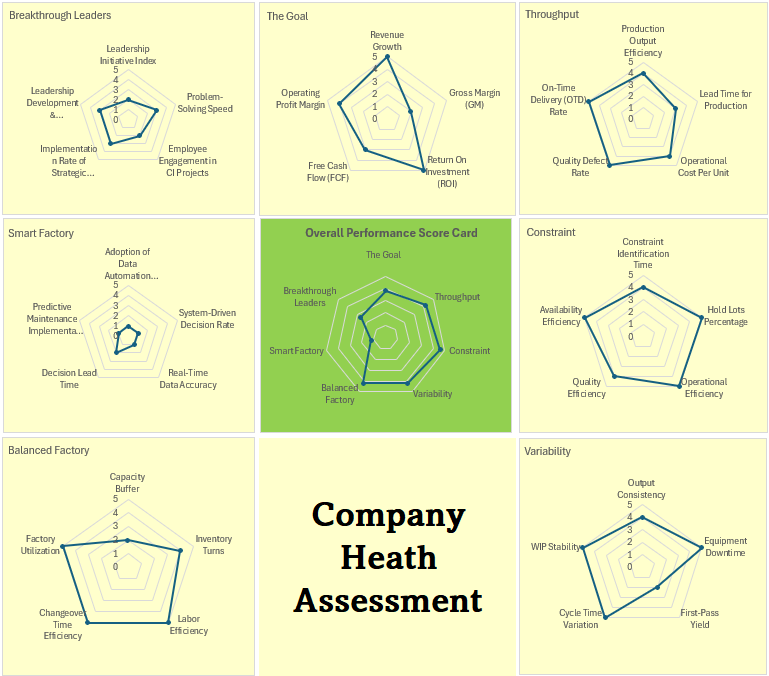
For example, an assessment report might reveal that while the company excels in production throughput, it struggles with Data Automation, causing delays in decision-making. It could also highlight gaps in Leadership Engagement, showing that continuous improvement initiatives are not being driven effectively. With this knowledge, the management team can align its focus, resources, and strategies on improving automation and strengthening leadership accountability—ensuring that efforts deliver measurable results.
By leveraging this tool, organizations can move from reactive problem-solving to a proactive, strategic approach, making informed decisions that lead to sustainable growth and operational excellence.
Are You Ready to See What You’ve Been Missing?
If you want to measure where you stand and identify untapped opportunities, take the next step. Because you don’t know what you don’t know—until you do.
 Engaged