

In any production system, identifying the constraint is essential. The constraint shows the process step with the lowest capacity, directly influencing throughput and, ultimately, sales. Any improvements made to a non-constraint process will not enhance overall performance and lead to inefficiencies.
Principle #3: Constraint Dictates Throughput Performance
Consider a simple three-step production line: Step 1 → Step 2 (Constraint) → Step 3

If Step 2 has the lowest capacity, it becomes the bottleneck. This is where all efforts should be focused. The key is to exploit the constraint—ensuring it operates at maximum efficiency while producing only what aligns with real customer demand.
The Five Focusing Steps of the Theory of Constraints (TOC)
Dr. Eliyahu Goldratt introduced the Theory of Constraints (TOC) as a systematic approach to improving processes by focusing on constraints. The five focusing steps guide businesses in optimizing their operations:
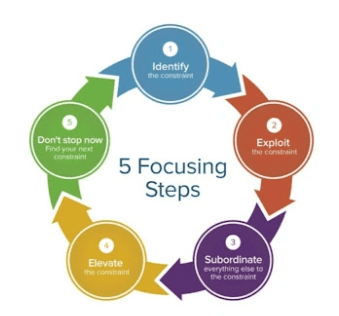
- Identify the Constraint
The first and most critical step is recognizing the process step that limits overall throughput. This is the weakest link in the system—the bottleneck that determines the maximum output rate. Identifying the constraint requires data-driven analysis, including measuring cycle times, work-in-progress (WIP) levels, and machine utilization. - Exploit the Constraint
Once identified, the constraint should be fully utilized before adding additional resources. The goal is to ensure the constraint is always operating on tasks that add value. Strategies include reducing downtime, eliminating unnecessary tasks, and optimizing scheduling so the constraint is never idle or working on non-priority tasks. - Subordinate Everything Else
All other processes must be aligned to support the constraint’s optimal performance. This means adjusting upstream and downstream workflows to ensure the constraint is neither overloaded nor starved of input. Processes that feed into the constraint must operate at a rate that ensures a smooth and uninterrupted workflow, avoiding excess inventory buildup or production delays. - Elevate the Constraint
If, after optimization, the constraint still limits throughput, it must be elevated. This can involve increasing capacity by adding machines, personnel, or outsourcing. The decision to elevate the constraint should be backed by thorough analysis to justify the investment. Once elevated, the constraint will shift to another part of the system, requiring a reassessment of bottlenecks. - Repeat the Process
The process of identifying and improving constraints is continuous. Once a constraint is resolved, another limiting factor will emerge. Businesses must maintain a culture of continuous improvement, regularly reassessing and optimizing constraints to drive sustainable operational excellence.
Strategies for Optimizing the Constraint
✅ Maximize Efficiency
- Keep Availability Efficiency above 95% by minimizing downtime.
- Maintain Operational Efficiency above 90% by optimizing process speed.
- Ensure Quality Efficiency above 95% to reduce defects and rework.
✅ Prioritize Resources
- Keep the constraint running at all times when there is real customer demand.
- Protect the constraint from variability by maintaining adequate Work-in-Process (WIP) buffers.
- Ensure timely maintenance and availability of raw materials to prevent disruptions.
✅ Elevate the Constraint When Necessary
- Optimize raw output per hour (UPH) by reducing cycle time.
- Invest in additional capacity by adding machines, increasing manpower, or outsourcing.
- Continuously monitor performance to identify when a new constraint emerges.
The Science Behind It
Dr. Eliyahu Goldratt introduced the Theory of Constraints (TOC) in his best-selling book The Goal (1994). TOC asserts that every system has one limiting factor—the constraint—that governs overall performance. Improving this one factor leads to significant gains in productivity and profitability.
By continuously identifying, exploiting, and elevating constraints, organizations can achieve higher throughput and sustained operational excellence. The constraint dictates performance—manage it strategically!
#OperationsManagement #TheoryOfConstraints #ManufacturingExcellence #ProcessImprovement #LeanThinking #ContinuousImprovement
 Engaged