


This is the most fundamental question that every business owner or manager must answer. It is not enough to simply have a mission, a vision, or a great idea—the business must be financially viable to sustain itself and achieve its objectives.
No matter the industry, function, or size, every business shares a common and inescapable reality— A Business Must Make Money to Survive and Grow.
If a business is not generating revenue by selling products or services, it will eventually fail. When that happens, the impact is widespread:
✅ Employees lose their jobs and income
✅ Suppliers lose a customer and experience financial setbacks
✅ Service providers that depend on the business for contracts and partnerships also suffer
✅ Communities that rely on the business for economic activity, employment, and support are affected
In essence, the ability to make money is what sustains everything—from paying salaries and suppliers to funding innovation and expansion.
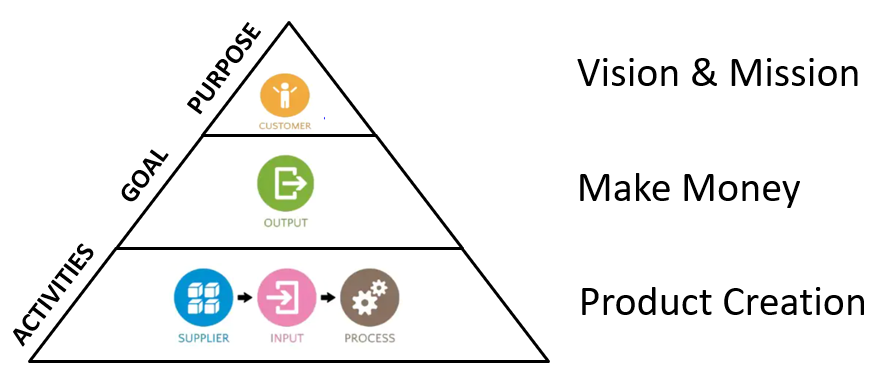
The Business Process: Turning Inputs into Profits
A business operates by transforming raw materials into finished goods or services. These are then delivered to customers in exchange for revenue. This cycle is crucial in maintaining business continuity.
1️⃣ Input – Raw materials, components, labor, and knowledge provided by suppliers
2️⃣ Process – Manufacturing, production, or service delivery that adds value
3️⃣ Output – Finished products or services ready for sale
4️⃣ Revenue – The return on investment, measured by products or services that are SOLD
📌 Revenue is equivalent to THROUGHPUT—the actual sales that generate money for the company.
If there is no throughput, the business is not making money. If the business is not making money, it is on the path to closure.
Beyond Profit: The Role of Business Growth
While making money is the primary goal, it is not enough to just break even. Businesses must continually grow to:
✔️ Stay competitive in an evolving market
✔️ Invest in new technology, products, and services
✔️ Improve employee compensation and benefits
✔️ Expand market reach and customer base
✔️ Contribute to economic development
Growth is not an option—it is a necessity for long-term survival. A stagnant business is a declining business.
Business Goal vs. Business Purpose
It is important to distinguish between the business goal and the business purpose:
- The Business Goal is to make money and continually grow
- The Business Purpose is to create value for customers, employees, and society
While businesses aim to contribute positively to the world, they cannot achieve this without financial sustainability. A company that does not generate profit will be unable to:
🔹 Develop better products and services
🔹 Support its workforce and their families
🔹 Give back to the community
🔹 Invest in future innovations
💡 Profitability is not greed—it is survival and sustainability.
The Bottom Line
A successful business is one that makes money consistently while ensuring growth and sustainability. This principle applies to all businesses—large or small, startup or established corporation.
📌 The goal of the business is not just to exist—it is to thrive, expand, and create long-term value.
Reflect on Your Business:
- Are you actively ensuring your business is financially viable?
- What strategies are you implementing for growth and sustainability?
- How can you balance profitability with your broader purpose?
By addressing these questions, business leaders can take actionable steps toward long-term success.
 Engaged